News Photo

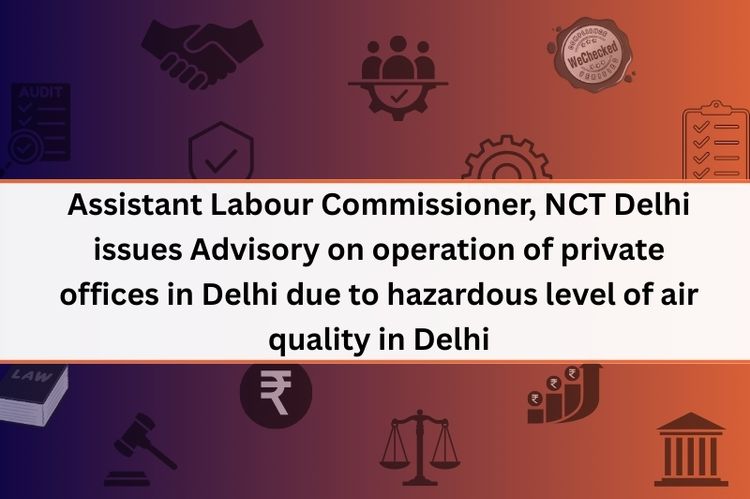
Assistant Labour Commissioner, NCT Delhi issues Advisory on operation of private offices in Delhi due to hazardous level of air quality in Delhi

  • Blogs
  • December 23, 2025
```html
Advisory Note
GRAP Work-from-Home Directions for Delhi–NCR: Gurugram and NCT of Delhi Advisories (December 2025)
In view of air-quality deterioration and the Graded Response Action Plan (GRAP) measures in Delhi–NCR, the Office of the Deputy Commissioner, Gurugram and the Office of the Secretary-cum-Commissioner (Labour), Government of NCT of Delhi have issued advisories to reduce commuter-related vehicular movement and associated emissions. This page summarises the directions, exemptions, enforcement position, and employer-action points.
Immediate employer relevance
Private institutions and corporate offices are expected to operationalise work-from-home or reduced physical attendance arrangements in line with GRAP directions, with specific reference to limits on physical staffing and measures to minimise office-commute vehicular movement.
Core intent
The advisories focus on curbing commuter traffic to limit incremental pollution during periods of poor air quality, while enabling continuity of work through remote or staggered operations.
Advisory 1: Deputy Commissioner, Gurugram (dated 21 December 2025)
District Gurugram
The Office of the Deputy Commissioner, Gurugram, referencing the Commission’s order on invoking Stage IV of GRAP in Delhi and NCR, has urged all private institutions and corporate offices in District Gurugram to guide employees to work from home with effect from 22 December 2025 until further orders.
Employers should treat this as an operational directive to reduce office commute and vehicle movement during the applicable GRAP period and maintain business continuity through remote working arrangements.
Advisory 2: Additional Labour Commissioner, Government of NCT of Delhi (dated 12 December 2025)
NCT of Delhi
An advisory dated 12 December 2025 was issued regarding implementation of the “Graded Response Action Plan (GRAP)” pursuant to the hearing of the Hon’ble Supreme Court in WP(C) No. 13089 of 1985 titled M.C. Mehta vs Union of India & Ors.
Current measure (referenced as moved for implementation)
“NCR State Governments/GNCTD to take a decision on allowing public, municipal and private offices to work on 50% strength and the rest to work from home.”
The advisory notes the need for tighter controls on vehicular movement due to very poor air quality and associated harmful pollutant release.
Order reference Operational direction for private offices in NCT of Delhi
F.No.10(39)/VENV/2021/6539-6556 dated 24.11.2025 All private offices functioning within NCT of Delhi shall operate with not more than 50% staff physically attending the workplace. The remaining staff shall mandatorily work from home. Private entities are further expected to implement staggered working hours where feasible, ensure strict compliance with work-from-home norms, and minimise vehicular movement associated with office commute.
Enforcement note
Employers are advised to adhere to the directions issued under the above order. Non-compliance is stated as punishable under Sections 15 and 16 of the Environment (Protection) Act, 1986 and other applicable laws.
Exempted services and establishments (as specified)
Exemptions are stated for hospitals and other public/private health establishments, fire services, prisons, public transport, electricity, water, sanitation and related municipal services, disaster management and related services, forest and environment departments/agencies engaged in air pollution control, monitoring and enforcement activities, and other essential/emergency services.
Employers operating in exempted categories should still adopt best-practice scheduling and commute-minimisation measures to the extent feasible while maintaining continuity of essential operations.
Supreme Court and stakeholder consultation context (as referenced)
Pursuant to the hearing held on 17.11.2025 in WP(C) No. 13089 of 1985, titled M.C. Mehta vs Union of India & Ors., the Commission proposed revisions in the GRAP schedule through a note submitted before the Hon’ble Supreme Court.
The Hon’ble Supreme Court observed that proactive action may be taken based on consultation with stakeholders for preventing further deterioration of air quality in Delhi–NCR. The Commission’s Sub-Committee on GRAP conducted a stakeholder consultation on 20.11.2025 and agreed to amend the GRAP schedule, after which the referenced Labour Department advisory was issued.
Air quality context and disruption impact (as provided)
Delhi AQI
The real-time air pollution level in Delhi has been described as rising from an AQI of 153 in 2020 to 270 in 2025, with the highest being 384. The air-quality calendar for December 2025 up to 21 December 2025 was referenced for day-wise trend visibility.
Reported operational and health disruptions
Dense smog conditions have been associated with travel disruptions including flight cancellations and delays, train delays, and increased hospital visits for breathing difficulty and eye irritation. Authorities have been described as banning certain construction activities, restricting diesel generators and vehicles, deploying water sprinklers, and permitting schools and offices to keep people at home. Seasonal factors mentioned include crop-residue burning, temperature inversion effects, and cumulative emissions from vehicles, construction and industry.
Employer action guidance (compliance-forward)
Workforce deployment
Implement work-from-home wherever directed or feasible; where physical attendance is permitted, align staffing to a 50% physical attendance model for NCT of Delhi private offices as referenced, and use staggered hours to reduce peak-hour commuting.
Documentation and audit readiness
Maintain internal communications evidencing the applicable work arrangement, roster, and attendance controls. Record exemptions (if applicable) and operational necessity justifications for essential roles.
Commute minimisation
Reduce office-commute vehicle movement by limiting in-office days, using shift staggering, encouraging remote meetings, and consolidating on-site tasks into fewer attendance days.
Employee well-being
Circulate health advisories aligned to official directions, provide flexibility for vulnerable employees, and ensure managers apply remote working norms consistently without avoidable escalation.
For more information and assistance
Write to our team for advisory interpretation, internal rollout drafts, and compliance-aligned communication templates.
Disclaimer: This page is an informational communication prepared from the content provided. For official applicability, enforcement scope, and exemptions, refer to the notified GRAP directions and the specific orders/advisories issued by the competent authorities.
```

Share This News

Comment

Your Trusted Partner in Compliance, Audits & Human Resource Solutions