News Photo

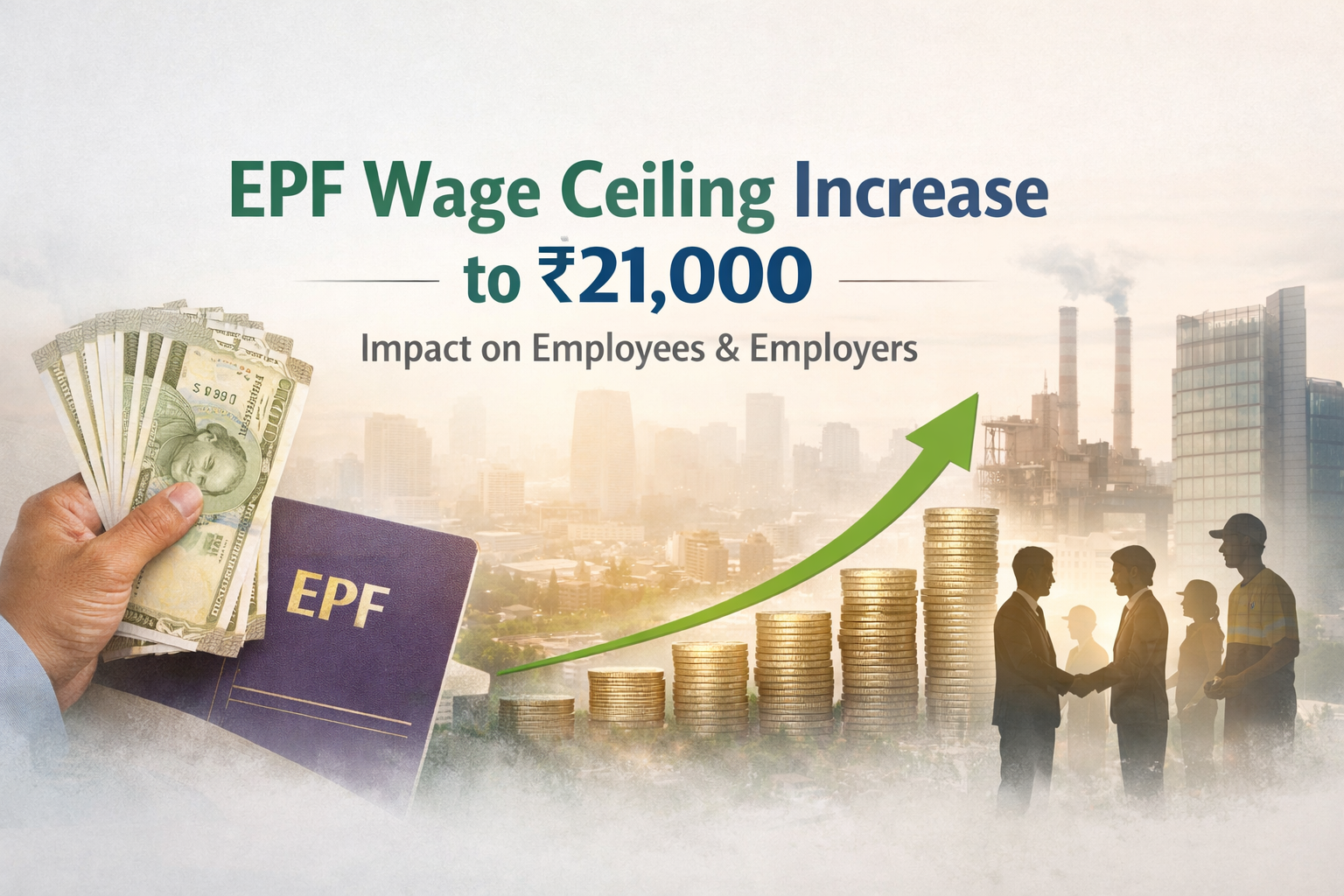
What will change if the current EPF wage ceiling limit of 15,000 gets increased to 21,000

CNBC TV18 • 8 January 2026
If EPF Wage Ceiling Moves from ₹15,000 to ₹21,000: What Changes for Employees and Employers
CNBC TV18 (dated 8 January 2026) captured the thoughts of Pratik Vaidya, CVO & MD, Karma Management Global Consulting Solutions Pvt. Ltd. (Karma Global), on the likely impact of raising the current EPF wage ceiling limit from ₹15,000 to ₹21,000.
Key theme
A larger segment of the workforce enters the social security net—supporting stronger retirement preparedness and a deeper pool of long-term investible funds.
What may improve
Higher monthly EPF contributions can compound into a meaningfully larger retirement corpus over time.
What varies by sector
Public sector continuity differs from private sector realities such as job changes, career breaks, or time outside formal employment.
Who must prepare
Employers—especially MSMEs and labour-intensive industries—may see higher wage costs and will benefit from cost simulation and readiness planning.
CNBC TV18 excerpt
“An increase in the EPF wage cap can lead to higher monthly contributions and, over time, a much larger retirement corpus,” said Pratik Vaidya, Managing Director and Chief Vision Officer, Karma Management Global Consulting Solutions Pvt Ltd.
“This can improve long-term financial security and support a better standard of living after retirement.”
He further noted that the practical impact can differ across sectors—public sector employees typically have continuity of service, while private sector workers may face breaks due to job transitions, career pauses, or periods outside formal employment.
Why the ceiling matters
The wage ceiling anchors contributions across the linked schemes—EPF, EPS and EDLI. The current ceiling of ₹15,000 has not been revised since 2014, even as wage structures and minimum wages have moved upward in several states.
A change in the ceiling can alter
Contribution basis, retirement corpus scale, EPS pension outcomes, EDLI coverage access, employer cost exposure, and payroll compliance design.
What is excluded from wages
The legal and operational context driving the debate
The Supreme Court has reportedly provided a four-month window to consider the current EPF wage ceiling in consequence of a plea filed by an activist. The contention highlights the exclusion from mandatory coverage of employees with basic salary exceeding ₹15,000 per month.
A core concern is that the ceiling continues to shape coverage across EPF, EPS and EDLI, while wage benchmarks in several states have moved beyond the existing threshold.
Practical scenarios observed in establishments
1. PF contributions aligned to minimum wages, which may be below or above the ₹15,000 ceiling.
2. Basic wages higher than ₹15,000, but employer restricts contributions to the ceiling amount.
3. Basic wages significantly higher than the ceiling, with contributions on actual higher basic salary.
4. New employees joining after 1 September 2014 with basic wages above ₹15,000 may not be mandatorily covered unless they opt in under Para 26(6) of the EPF Scheme.
5. Entry-level salaries in many establishments already exceed the ₹15,000 ceiling.
These scenarios influence whether employees effectively participate in the PF retirement corpus, EPS pension outcomes, and EDLI insurance coverage.
Wage benchmarks (2025–26 estimates)
Current Minimum Wages by State (per month)
Many arguments note that exclusion above ₹15,000 appears misaligned with current wage realities, especially where minimum wages in some states exceed the existing ceiling. As stated, as of 21 November 2025, minimum wages are governed by the Code on Wages, 2019 (replacing the Minimum Wages Act, 1948).
State Effective Date Unskilled Skilled Highly Skilled
Maharashtra 1 July 2025 ₹16,867 (Zone I)
₹16,027 (Zone II)
₹19,392 (Zone I)
₹18,552 (Zone II)
N/A
Karnataka 1 April 2025 ₹15,701.43 (Zone I)
₹15,149.63 (Zone II)
₹14,624.10 (Zone III)
₹14,123.60 (Zone IV)
₹18,134.87 (Zone I)
₹17,467.19 (Zone II)
₹16,831.31 (Zone III)
₹16,225.70 (Zone IV)
₹19,537 (Zone I)
₹18,802.55 (Zone II)
₹18,103.08 (Zone III)
₹17,436.91 (Zone IV)
Delhi 1 April 2025 ₹18,066 ₹22,411 N/A
Chandigarh 1 October 2025 ₹14,394 Class I ₹14,844
Class II ₹15,069
₹15,469
Gujarat 1 October 2025 ₹13,013 (Zone I)
₹12,727 (Zone II)
₹13,273 (Zone I)
₹13,013 (Zone II)
N/A
Jharkhand 1 October 2025 ₹13,050 ₹18,042 ₹20,802
Meghalaya 1 April 2025 ₹13,650 ₹15,730 ₹16,770
Punjab 1 September 2025 ₹11,389.64 ₹13,066.64 ₹14,098.64
Uttarakhand 1 April 2024 ₹12,539 – ₹12,391 ₹14,023 – ₹13,838 N/A
Andhra Pradesh 1 October 2025 ₹11,701 Skilled A ₹8,438
Skilled B ₹8,438
Skilled C ₹8,438
₹14,488
Madhya Pradesh 1 October 2025 ₹12,150 ₹14,869 ₹16,494
Rajasthan 13 December 2025 ₹7,410 ₹8,034 ₹9,334
Chhattisgarh 1 October 2025 to 31 March 2026 Class A ₹11,176
Class B ₹10,916
Class A ₹12,346
Class B ₹12,086
Class A ₹13,386
Class B ₹13,126
Impact analysis
What happens if the equation changes to ₹21,000
Wider coverage
A higher ceiling can bring a larger segment of employees within the PF net, especially where entry-level and mid-level wages already exceed ₹15,000.
Tax treatment focus
Contributions and accumulations typically remain structured for tax efficiency at the base level, influencing employee preference between take-home pay and long-term savings.
Pension outcomes
A higher pensionable salary ceiling can lift the EPS pension baseline for eligible members compared to the current scenario where many members receive the minimum pension.
EPS formula illustration at ₹21,000 ceiling
Pension = (Years of service × Pensionable salary) / 70
On a pensionable salary cap of ₹21,000 and a service period of 35 years, the illustrative pension value would be:
₹10,500 (₹21,000 × 35 / 70)
Illustration as provided in the content; actual computation is subject to scheme conditions and records.
Note: An employee cannot be a member only of EPS; EPS is linked with EPF membership and applicable scheme rules.
Example: service period of 23 years (age 35 to 58)
Monthly salary ₹23,000; pensionable salary capped at ₹21,000 (revised ceiling).
Pension = (23 × ₹21,000) / 70
Estimated monthly pension
₹6,900
Without the increased ceiling limit, the illustration states approximately ₹4,929 per month.
This is an illustrative scenario as provided; actual benefits depend on scheme parameters and service records.
Employer-side impact and readiness
A higher ceiling can increase wage costs while potentially reducing employee take-home. For MSMEs and labour-intensive industries, preparedness through cost simulation and structured rollout planning becomes commercially important.
Employers may need to provision additional contributions on the incremental band between ₹15,001 and ₹21,000 per employee, along with a marginal rise in PF administrative charges and EDLI charges (as stated).
Why many view it as a positive move
Experts believe raising the wage ceiling could bring more workers into mandatory social security benefits and align the threshold with prevailing salary levels. It may also reduce misuse and improve payroll transparency, albeit with higher compliance intensity.
Why some employees may resist
Some employees may prefer higher immediate take-home pay rather than increased retirement allocations. Because EPS is structured as a monthly pension (unlike EPF’s lump-sum accumulation), retirement timelines and pension needs shape individual preferences.
Scale snapshot (as stated)
10 million+
Illustrative estimate of additional workers that could enter mandatory social security benefits if the ceiling rises above ₹15,000.
₹26 lakh crore
Total fund size managed by EPFO (as stated).
76 million
Approximate active EPFO member base (as stated).
Compliance guidance and implementation support
Write to the Karma Global team
marketing@karmamgmt.com
Payroll impact simulation, contribution structuring, compliance mapping, and transition support can be planned in advance to reduce disruption and enhance retirement outcomes.

Share This News

Comment

Your Trusted Partner in Compliance, Audits & Human Resource Solutions